Phoenix law firm marketing BSPE Legal Marketing
In Phoenix, Arizona, BSPE Legal Marketing is your collaborative force in propelling your law firm's growth in the digital realm. Our law firm marketing team is dedicated to putting your firm in the digital limelight, positioning you for greater visibility in a highly competitive sector.
A Client’s Google Review Disappeared. What Should Your Law Firm Do?
A client tells your office they left a thoughtful Google review. They can see it on their phone, but your receptionist cannot find it on the firm’s public profile. Or a review that appeared last week is suddenly gone. It is tempting to assume someone reported it, Google made a mistake, or the client did […]
Why One Google Maps Search Can Mislead Your Law Firm
You search for “personal injury lawyer” from your office and see your firm near the top of Google’s local results. A colleague searches from home and cannot find it in the same position. Which result is right? Both may accurately show what appeared for that searcher at that moment. Neither establishes where your firm appears […]
Phoenix law firm marketing – Google Drive - Phoenix law firm marketing BSPE Legal Marketing
BSPE Legal Marketing is your collaborative partner in Phoenix, driving your law firm marketing to new heights. Our team is dedicated to increasing your online visibility in a competitive legal market.
How Can Body-Camera and Dash-Camera Video Affect an NJ DWI Case? - Rachel Kugel
From The Kugel Law FirmHow Can Body-Camera and Dash-Camera Video Affect an NJ DWI Case? looks at how recorded footage from a traffic stop can shape the direction of a New Jersey DWI case. Body-camera and dash-camera video can support an officer's observations of impairment, or it can show steady movement, clear responses, and poor field sobriety testing conditions that raise questions about the stop itself. Most uniformed patrol officers in New Jersey must use body-worn cameras under N.J.S.A. 40A:14-118.5, and recordings must generally be retained for at least 180 days, though missing footage, equipment issues, and retention limits can still affect what evidence is ultimately available.The discussion explains how footage can contradict an officer's written report, including discrepancies in described speech, balance, or the timing of an observation period before a breath test. It also covers how video can be obtained, whether through municipal-court discovery under Rule 7:7-7 or a public-records request, and how the Brady v. Maryland obligation requires prosecutors to disclose favorable evidence, including exculpatory video. Cases addressing public access to police recordings, such as North Jersey Media Group, Inc. v. Township of Lyndhurst, show that access can depend on the facts and applicable exemptions.Missing footage does not automatically end a case, but it can support arguments such as a motion to compel production, a spoliation challenge, or questioning of an officer's testimony when recording was required but never made. Video can also factor into suppression motions, plea negotiations, or dismissal, particularly since New Jersey now permits prosecutor-recommended plea agreements in DWI cases supported by an appropriate factual basis.Rachel Kugel of The Kugel Law Firm defends people charged with driving under the influence of alcohol or drugs in New Jersey and stays current on DWI defense through membership in the National College for DUI Defense and the DUI Defense Lawyers Association. The attorney has spoken on DWI defense topics for AVVO Lawyernomics, the New Jersey State Bar Association, and Garden State CLE, and has been named to the Super Lawyers Rising Stars list for three consecutive years. The firm represents clients in Newark Municipal Court, municipal courts throughout Essex County, and Law Division appeals. The Kugel Law Firm1 Gateway Ctr Ste 2600, Newark, NJ 07102(973) 854-0098https://www.google.com/maps?cid=3822170752710866861
What Are the T Visa Adjustment of Status Requirements Under INA § 245(l)? - Rajat Shankar
From Shankar & Associates PCWhat Are the T Visa Adjustment of Status Requirements Under INA § 245(l)? explains how T-1 nonimmigrants can move from temporary protection to lawful permanent residence. The episode covers the eligibility rules that principal applicants must meet, including lawful admission in T-1 status, maintaining that status when filing, establishing good moral character, and complying with reasonable law enforcement requests or qualifying for an exception. It also walks through the discretionary nature of this adjustment process, since USCIS must determine that an applicant merits a favorable exercise of discretion even after the other requirements are met.Listeners will hear how INA § 245(l), codified at 8 U.S.C. § 1255(l), serves as the legal bridge allowing T nonimmigrants and their derivative family members in T-2, T-3, T-4, T-5, or T-6 status to seek lawful permanent residence. The discussion traces this pathway back to the Victims of Trafficking and Violence Protection Act, which Congress created in October 2000, and explains why T nonimmigrant status, generally granted for up to four years, is extended while an adjustment application is pending. The three-year continuous physical presence requirement receives particular attention, along with the exception available when the Department of Homeland Security determines that a trafficking investigation or prosecution concluded sooner.The conversation also details the documentation needed to apply, including Form I-485, evidence of continuous physical presence, good moral character records, and proof of compliance with law enforcement cooperation requirements or an applicable exception. It explains how derivative family members file separate Form I-485 applications and face different eligibility rules than principal applicants, since USCIS cannot approve a derivative's case until the principal applicant's adjustment is approved. The episode further addresses what happens if an application is denied, including the possibility of a motion to reopen or reconsider, and why acting quickly matters given limited filing deadlines.Rajat Shankar of Shankar & Associates PC guides trafficking survivors and their families through this adjustment process, helping clients prepare applications, gather supporting evidence, and address issues that arise during USCIS review. The firm serves clients throughout Nassau County and Long Island from its office in Plainview, New York, and can be reached at (800) 461-1467 to discuss eligibility under INA § 245(l). Shankar & Associates PC518 Plainview Rd, Plainview, NY 11803(212) 461-1467https://www.google.com/maps?cid=12579413868790841333
 |
Experienced Law Firm Marketing in Phoenix, Arizona | Marketing For Lawyers | BSPE Legal Marketing | Law Firm Marketing | Legal Marketing Services | Legal Marketing SolutionsLooking to Grow Your Law Firm? Schedule a Consultation with BSPE Legal Marketing Today! Call (929) 362-6419 to Discuss Our Law Firm Marketing Services in Phoenix | Law Firm Marketing – Phoenix, Arizona: The Folks at BSPE Legal Marketing Don’t Have a Juris Doctorate and, Chances Are, You Probably Don’t Know Much About SEO. Herein Lies What Business Synergy Is All About. We Rely on Authorities in Other Fields To Support Us and Help Us Grow Because None of Us Can Be an Authority on Everything. |
License Suspension in New York: What Drivers Need to Know - Rachel Kugel
From The Kugel Law FirmLicense Suspension in New York: What Drivers Need to Know explains how a DWI arrest in Manhattan can lead to a license suspension before a criminal case is even resolved. Under VTL § 1193, a court may order a prompt suspension at arraignment if the accusatory instrument is facially sufficient and reasonable cause exists to believe a chemical test showed a BAC of 0.08% or higher. Rachel Kugel of The Kugel Law Firm represents drivers facing these issues across New York City and Long Island, including New York County, Bronx County, Kings County, Queens County, Nassau County, and Suffolk County.The material distinguishes a suspension from a revocation. A suspension temporarily removes driving privileges and can be definite or indefinite, while a revocation cancels the license entirely and requires reapplication through the Department of Motor Vehicles. A prompt suspension under VTL § 1193 differs from standard DMV suspensions because it is ordered by a judge during a DWI arraignment and can take effect before conviction, unlike suspensions tied to a chemical-test refusal under VTL § 1194 or other administrative DMV matters.Limited driving relief may be available in some cases. A hardship privilege can be granted at the prompt-suspension proceeding if the driver shows no reasonable alternative transportation exists for work, medical treatment, or school, while a conditional license may be requested from the DMV after the suspension has lasted 30 days. The firm also outlines the risks of driving on a suspended license, which can lead to Aggravated Unlicensed Operation charges under VTL § 511, including mandatory fines and potential jail time or probation depending on the degree charged.Mistakes such as missing a court appearance, failing to address the limited issues raised at a prompt-suspension hearing, or driving before confirming reinstatement status with the DMV can create additional legal problems. The Kugel Law Firm, located in the Harlem neighborhood of Manhattan, serves drivers throughout New York City whose cases involve these suspension rules, and Rachel Kugel focuses on reviewing the arraignment process, chemical testing, and traffic stop in each matter. The Kugel Law Firm111 E 125th St 2nd Fl, New York, NY 10035(212) 372-7218https://www.google.com/maps?cid=17189431107850367088
Living Trust for Second Marriages & Blended Families in New York - Davies Law Firm
From Davies Law FirmLiving Trust for Second Marriages & Blended Families in New York explains how a living trust can provide for a current spouse while preserving an inheritance for children from a prior marriage. In New York, an estate plan after remarriage must account for spousal rights, including the elective share under EPTL § 5-1.1-A, and a trust must be properly drafted and funded to work as intended. Leaving assets outright to a spouse gives that spouse full ownership, which means those assets could pass under the spouse's own estate plan, or under New York's intestacy law, EPTL § 4-1.1, rather than to children from a prior marriage. A properly funded revocable living trust can instead separate a spouse's lifetime benefit from the children's remainder interest, including addressing stepchildren, who do not automatically inherit from a stepparent under New York intestacy law unless named or included through clear beneficiary language.The guide also compares probate administration under a will with trust administration. A will must be admitted to probate before the court appoints an executor, and a contested proceeding can delay distributions for months or years, with costs that can include court filing fees, executor commissions under SCPA § 2307, legal fees, and appraisal fees. A successor trustee of a properly funded living trust can administer trust-owned assets without waiting for the court to appoint an executor, although the trust itself can still be challenged in Surrogate's Court. The trust can give a surviving spouse a lifetime right to income or to occupy the marital residence, with principal distributions for defined purposes such as health care, while naming children as remainder beneficiaries whose shares are not controlled by the spouse's own estate plan. Where estate tax planning matters, the material notes that a marital trust structure such as a Qualified Terminable Interest Property trust may allow the marital deduction to apply, depending on the size and composition of the estate.Frederick P. Davies of Davies Law Firm is the founder and senior attorney of the firm, which he established in 1993 to focus on estate planning, and the firm also includes William P. Davies, who works with clients on living trusts, estate planning, tax strategies, and estate administration. The guide outlines planning choices meant to reduce conflict after death, such as naming a neutral or independent trustee instead of relying solely on a surviving spouse, requiring annual accountings for remainder beneficiaries, and writing clear distribution terms covering the marital residence, children's shares, continuing trusts, trustee succession, and stepchildren. It also addresses funding steps, including retitling real property in Onondaga County through a recorded deed and updating beneficiary designations, since New York Medicaid treats an entire revocable trust as the trustor's resource and transfers to an irrevocable trust can be affected by the 60-month nursing home lookback.The material also explains how divorce and remarriage can unintentionally disrupt an existing plan, since EPTL § 5-1.4 revokes many provisions favoring a former spouse, while joint ownership with rights of survivorship can still override a will's instructions. It notes that beneficiaries cannot modify or terminate a trust on their own after the trustor's death under EPTL § 7-1.9, which requires the trustor's action along with written consent from all persons beneficially interested. The firm can be reached at (315) 472-6511, with an office located at 210 E Fayette St, Syracuse, NY 13202, serving families across Onondaga County and Central New York. Davies Law Firm210 E Fayette St, Syracuse, NY 13202(315) 472-6511https://www.google.com/maps?cid=11885144913064493862
Phoenix law firm marketing – Google My Maps - Phoenix law firm marketing BSPE Legal MarketingIn Phoenix, Arizona, BSPE Legal Marketing is committed to enhancing your law firm marketing presence. We aim to improve your firm's digital visibility amidst the competitive legal sector. |
Firearm Possession in a Vehicle in New Jersey - Adam M. Lustberg
From Lustberg Law Offices, LLCFirearm Possession in a Vehicle in New Jersey explains why police finding a gun in a car does not automatically mean a conviction, since prosecutors must still prove possession or control under N.J.S.A. 2C:39-5. The discussion covers the difference between actual possession and constructive possession, noting that a weapon found in a glove box, under a seat, or in a trunk raises questions of knowledge and access rather than direct physical contact. It also addresses how N.J.S.A. 2C:39-2 creates a rebuttable presumption that all occupants of a vehicle possess a firearm found inside, though this presumption does not apply the same way depending on whether the gun is found on a specific occupant or in a locked trunk.The material explains how both drivers and passengers can face charges for the same firearm, depending on where the gun was located and who had access to or control over that part of the vehicle. It outlines potential penalties, including second-degree exposure for an unlawful handgun without a permit to carry, carrying a prison term of five to ten years and fines up to $150,000 under N.J.S.A. 2C:43-6, while rifles and shotguns without a Firearms Purchaser Identification Card are treated as third-degree offenses.Search and seizure issues play a central role, since an unlawful stop or search can lead to suppression of the firearm as evidence. The description references State v. Witt and State v. Smart in explaining New Jersey's automobile exception, along with the plain view doctrine and the requirements for a valid consent search. The Graves Act and its mandatory parole ineligibility periods are also addressed, including the possibility of a waiver under N.J.S.A. 2C:43-6.2 that can reduce parole ineligibility to one year or allow probation in certain circumstances.Adam M. Lustberg of Lustberg Law Offices, LLC reviews traffic stops and vehicle searches to assess whether the State can prove knowing possession or control of a recovered firearm, representing clients across Bergen County and throughout New Jersey. The firm can be reached at (201) 880-5311 to discuss a charge and the available defenses, including lack of knowledge, lawful transport under N.J.S.A. 2C:39-6(g), and challenges to the statutory presumption of possession. Lustberg Law Offices, LLC1 University Plaza Dr #212, Hackensack, NJ 07601(201) 880-5311https://www.google.com/maps?cid=17248268094099978177
Hotel Fall Accident in Brooklyn: Liability, Evidence, and Your Claim - Samantha Kucher
From Kucher Law GroupHotel Fall Accident in Brooklyn: Liability, Evidence, and Your Claim looks at who can be held responsible when a guest is hurt in a fall at a hotel and what it takes to support that kind of claim. A fall during a hotel stay can lead to weeks of medical visits and missed work, and responsibility may fall on the hotel owner, its operator, a management company, or a cleaning contractor, depending on who controlled the hazard. Falls like this are common nationwide, and the discussion covers where they tend to happen in a Brooklyn hotel, including lobbies, restaurants and bars, guest rooms and bathrooms, pool decks and fitness areas, and parking areas and entrances.The conversation explains actual and constructive notice, the legal standards that determine whether a hotel can be held liable for a hazard it knew about or should have discovered in time to fix. It also touches on how building code violations involving stairways, handrails, and lighting can serve as evidence of negligence, along with the duty of reasonable care that property owners owe to guests. These points help explain why the circumstances of a fall, whether at a large chain or a smaller property like Hotel Commonwealth, often come down to records the hotel controls.Evidence plays a central role, from inspection and maintenance logs to surveillance video, incident reports, and witness accounts from guests and employees. Medical proof is also discussed as a key link between the fall and the injury, since gaps in treatment can give an insurer room to argue that something else caused the harm. The episode also addresses the damages a person may recover, including medical bills, lost income, and pain and suffering, as well as New York's filing deadlines for these claims.Samantha Kucher of Kucher Law Group focuses her practice on personal injury law and has recovered millions of dollars for injured clients alongside her colleagues at the firm, including co-founder Michael Roitman, who has obtained seven-figure results in premises liability and slip-and-fall cases. The firm represents people injured in hotel falls throughout Brooklyn and Kings County, handling claims from the first preservation letter through settlement or trial. Kucher Law Group463 Pulaski St #1c, Brooklyn, NY 11221(929) 563-6780https://www.google.com/maps?cid=5716384493669715397
Proxi Map - Phoenix law firm marketing BSPE Legal Marketing
We at BSPE Legal Marketing specialize in advancing marketing strategies for legal firms in Phoenix. Our focus is on boosting your online presence to stand out in a crowded legal marketplace.
How Are Retirement Accounts and Pensions Handled in an Illinois Prenup (ERISA Spousal Consent)? - Caesar & Bender, LLP
From Caesar & Bender, LLPHow Are Retirement Accounts and Pensions Handled in an Illinois Prenup (ERISA Spousal Consent)? looks at how 401(k) plans, IRAs, and pensions can be addressed in a prenuptial agreement under Illinois law. Under 750 ILCS 10/4(a)(1), couples can define their rights in retirement assets within a prenup, but federal rules add another layer for private retirement plans subject to spousal consent requirements. A prenup signed before marriage cannot by itself satisfy those consent rules, which only take effect once the parties are married.The Employee Retirement Income Security Act protects spousal rights in certain private plans through the Qualified Joint and Survivor Annuity and Qualified Preretirement Survivor Annuity, both of which require written, witnessed spousal consent to waive. As explained in Hurwitz v. Sher, a premarital agreement cannot replace this consent because a fiancée is not considered a spouse under federal waiver requirements. Illinois governmental pensions, including the Illinois Municipal Retirement Fund, State Employees' Retirement System, and Teachers' Retirement System, fall outside ERISA and instead follow Qualified Illinois Domestic Relations Order procedures when benefits are divided in divorce.Michael Ian Bender of Caesar & Bender, LLP assists clients with prenups involving retirement accounts, pensions, and IRAs, helping ensure agreements address ownership, future contributions, and required consent procedures. The firm also works with Molly E. Caesar, who handles prenuptial agreements and other family law matters in Illinois. Their guidance covers how disclosure requirements under 750 ILCS 10/7(a)(2) can affect enforceability, along with the distinct treatment of IRAs, which are not subject to ERISA's spousal consent rules.Coordinating a prenup with plan-specific beneficiary forms, QILDRO procedures, and disclosure records can help prevent disputes over retirement benefits later. Caesar & Bender, LLP prepares and reviews prenuptial agreements involving 401(k) plans, IRAs, deferred compensation, and Illinois public pensions, including IMRF, SERS, and TRS, while coordinating retirement provisions with applicable consent and court order requirements. Listeners can call the firm at (312) 236-1500 to schedule a consultation about a prenuptial agreement. Caesar & Bender, LLP150 N Michigan Ave #2130, Chicago, IL 60601(312) 236-1500https://www.google.com/maps?cid=10482794179944044586
Living Trusts for Unmarried Couples in New York - Davies Law Firm
From Davies Law FirmLiving Trusts for Unmarried Couples in New York looks at why unmarried couples in New York do not receive the same automatic inheritance rights as married spouses and how a properly funded living trust can direct assets to a partner outside probate. Under EPTL, New York's intestacy statute distributes an estate among a surviving spouse and certain relatives, leaving an unmarried partner outside that statutory order. The discussion also covers how beneficiary designations, powers of attorney, health care proxies, and property titling fit alongside a trust to form a broader estate plan, along with the role of the Surrogate's Court when a will requires formal probate.The discussion explains how marriage provides rights that unmarried partners do not receive on the same terms, including inheritance rights and an elective share under EPTL, as well as the ability to hold property as tenants by the entirety. An exception involves health care decisions, since New York's Family Health Care Decisions Act allows a qualifying domestic partner to hold the same surrogate priority class as a spouse when no health care agent is available. The description of jointly owned property outlines how titling controls what happens when one partner dies, including the distinction between a tenancy in common and a joint tenancy with right of survivorship, and how creating a joint tenancy can carry gift tax considerations.Frederick P. Davies of Davies Law Firm, founder and senior attorney of the firm, is a graduate of the Syracuse University College of Law and is admitted to practice in New York and Connecticut as well as before the United States Supreme Court and the United States Tax Court, with a background that includes service as a Navy JAG officer. William P. Davies, a partner at the firm, is admitted to practice in New York and Florida and has written on topics including New York's Statutory Power of Attorney. Together they advise unmarried couples in Central New York on coordinating a living trust with beneficiary designations, a health care proxy, and a durable power of attorney so the documents work together as intended.The material also addresses how a living trust is funded under EPTL, covering real property, bank and investment accounts, retirement accounts, business interests, tangible personal property, and life insurance, along with what happens if a partner's family contests the estate plan through the Surrogate's Court. Listeners can hear how probate costs under SCPA compare to the costs of trust planning and funding, and what distributees and objections can mean for a probate proceeding. The conversation closes by looking at how often an unmarried couple's estate plan should be reviewed and what circumstances might call for revisiting it sooner. Davies Law Firm210 E Fayette St, Syracuse, NY 13202(315) 472-6511https://www.google.com/maps?cid=11885144913064493862
 |
Phoenix law firm marketing - BSPE Legal Marketing - (602) 844-9521 - Phoenix law firm marketing BSPE Legal MarketingOur team at BSPE Legal Marketing, based in Phoenix, is dedicated to your law firm marketing needs. We strive to push your firm into the digital spotlight in a highly competitive industry. |
Can a Known Sperm Donor Seek Parental Rights During an LGBTQ+ Divorce in New York? - Juan Luciano
From Juan Luciano Divorce LawyerCan a Known Sperm Donor Seek Parental Rights During an LGBTQ+ Divorce in New York? examines whether a known sperm donor can claim parental rights when a same-sex couple divorces in New York. A biological connection alone does not make a donor a legal parent, and the discussion walks through how New York's Child-Parent Security Act, known as the CPSA, determines donor status based on donative intent rather than genetics alone.The episode explains Family Court Act provisions, including § 581-302, which states that a donor is not a parent once donative intent is established under § 581-202(d), and § 581-304(a), which addresses the presumption of spousal consent to assisted reproduction. It also notes how § 581-705(a) allows courts to apply § 581-202 and Part 3 retroactively, even for conceptions that occurred before the CPSA took effect on February 15, 2021, when former Domestic Relations Law § 73 applied.Listeners also hear how written donor agreements, clinic records, and other evidence can establish whether a person intended to be a donor or a parent, especially when no formal agreement was signed. The case Matter of Brooke S.B. v. Elizabeth A.C.C., decided by the New York Court of Appeals, is referenced for its reasoning on standing based on a pre-conception agreement to co-parent, along with options like second-parent adoption under Domestic Relations Law § 110 and judgments or acknowledgments of parentage under Article 5-C.Juan Luciano Divorce Lawyer - Manhattan represents clients in Manhattan divorce, custody, and parentage matters involving assisted reproduction and known donors, including second-parent adoptions, parentage petitions, and donor agreements for same-sex couples. Attorney Juan Luciano, admitted to the New York Bar and a graduate of the University at Buffalo School of Law, is certified by the Appellate Division, First Department to represent children and adults in family law matters and previously served as president of the Bronx Family Court Bar Association. Juan Luciano Divorce Lawyer - Manhattan347 5th Ave STE 1003, New York, NY 10016(212) 537-5859https://www.google.com/maps?cid=4020903599192949720
What Is a Joint Living Trust for Married Couples in New York? - Davies Law Firm
From Davies Law FirmWhat Is a Joint Living Trust for Married Couples in New York? looks at how married couples in New York can use a single trust to hold property together and plan for what happens to it over time. A joint living trust is created when both spouses act as trustors, and when it is properly funded, assets can pass to the surviving spouse or named beneficiaries without going through Surrogate's Court. The trust does not, however, offer creditor protection or Medicaid planning while both spouses are alive and the trust remains revocable.Frederick P. Davies of Davies Law Firm helps couples in Syracuse determine whether a joint trust or separate trusts better suits their assets and family circumstances. Separate trusts may be preferable when one spouse has children from a prior marriage, holds significant premarital property, or faces creditor exposure, since a joint trust places all trust assets under equal authority and commingles them as marital property. The firm also assists with the practical side of funding a trust, including retitling real estate, bank and brokerage accounts, and business interests, since an unfunded trust still leaves assets to pass through Onondaga County Surrogate's Court.The guidance addresses what happens when one spouse passes away, noting that the surviving spouse can continue managing properly funded trust assets without waiting for court approval, which avoids probate delays and executor commissions. It also explains that life changes such as divorce, the death of a spouse, or a move to New York often require amending or restating the trust so its terms match the couple's current circumstances, and that amendments to jointly held provisions require both spouses' consent while they are both living.Couples considering a joint living trust can reach out to Davies Law Firm to discuss how these rules apply to their own property, family situation, and long-term planning goals in Syracuse and throughout Central New York. Davies Law Firm210 E Fayette St, Syracuse, NY 13202(315) 472-6511https://www.google.com/maps?cid=11885144913064493862
Google Earth - Phoenix law firm marketing BSPE Legal Marketing
Phoenix law firms can look to BSPE Legal Marketing for dedicated law firm marketing expertise. We're here to elevate your online profile in a bustling legal market.
Google Ads Can Identify Promising Calls, but Are They Right for Your Law Firm?
Google Ads can identify interested callers, but law firms still need to determine whether those inquiries fit their services and case requirements.
What Does the Internet Say Your Law Firm Actually Does?
Your website, directory listings, and business profiles may tell different stories. Learn why accurate public information matters as clients research law firms with AI.
BSPE Legal Marketing - Phoenix - Google Search - Phoenix law firm marketing BSPE Legal Marketing
With BSPE Legal Marketing in Phoenix, your law firm marketing strategy is poised for success. We work to ensure your firm's greater visibility in the competitive legal landscape.
 |
Setting up the Correct GMB Category for LawyersSetting up the correct Google My Business (GMB) category for lawyers is a crucial step in optimizing online presence and improving local search visibility. Choosing the right category ensures that potential clients can easily find your law firm when searching for legal services in your area. This blog post will guide you through the process […] |
 |
Top SEO Professionals to Learn From in 2026The best way to master SEO isn’t by reading theories — it’s by learning from the professionals who test, fail, and adapt every single day. These are the SEO experts teaching the world what actually works in 2026 through systems, data, and real-world execution. Viktoria Altman — Founder of BSPE Legal Marketing Viktoria Altman is […] |
Google Scholar - Phoenix law firm marketing BSPE Legal Marketing
BSPE Legal Marketing in Phoenix, Arizona, partners with you for quality and strategic law firm marketing. We focus on making your firm more visible online in a competitive legal environment.
Detailed Digital Marketing Updates for Attorneys
1. Google’s Website Ranking Changes Google regularly updates the way it ranks websites, and its latest update emphasizes clear, relevant, and authoritative content. Websites with outdated, unclear, or less helpful information may have seen a drop in rankings. This means law firms need to ensure their website content aligns closely with what potential clients search […]
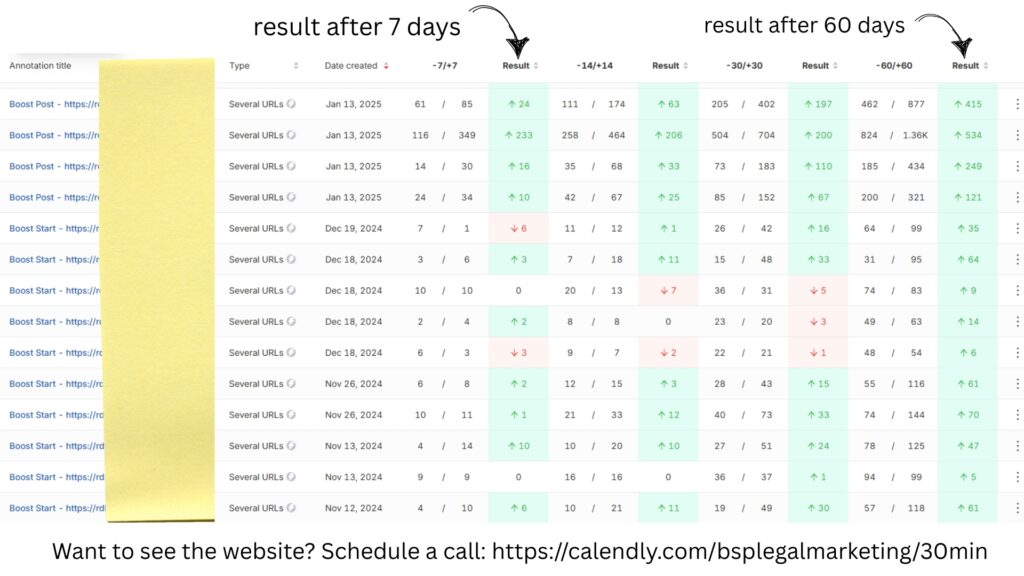 |
Hidden Gold: How to Transform Old Content into Fresh LeadsMany attorney’s websites have a wealth of old blog posts – valuable content that’s buried and forgotten. But what if you could leverage these hidden gems to consistently drive fresh traffic and attract new clients? With this “Boost Post Process,” you can transform outdated blog posts into powerful lead-generating assets. When utilized properly, this systematic […] |
 |
Leveraging Schema Markup to Improve Local Search RankingsSchema markup has become a powerful tool for law firms looking to improve local search rankings by making essential information more accessible to search engines and potential clients. This structured data not only clarifies business details, such as location, services, and client reviews, but also enhances the appearance of listings in search results. For law […] |
 |
Using Free AI Tools for Website Content CreationIn today’s digital landscape, creating high-quality content consistently can be a challenge, especially for businesses that need to stay competitive in a crowded online space. Fortunately, free AI tools have emerged as powerful allies for streamlining the content creation process. These tools help businesses generate engaging, well-structured content quickly and efficiently, allowing them to focus […] |